NIS2 Directive Explained: Who It Affects, Requirements & Penalties
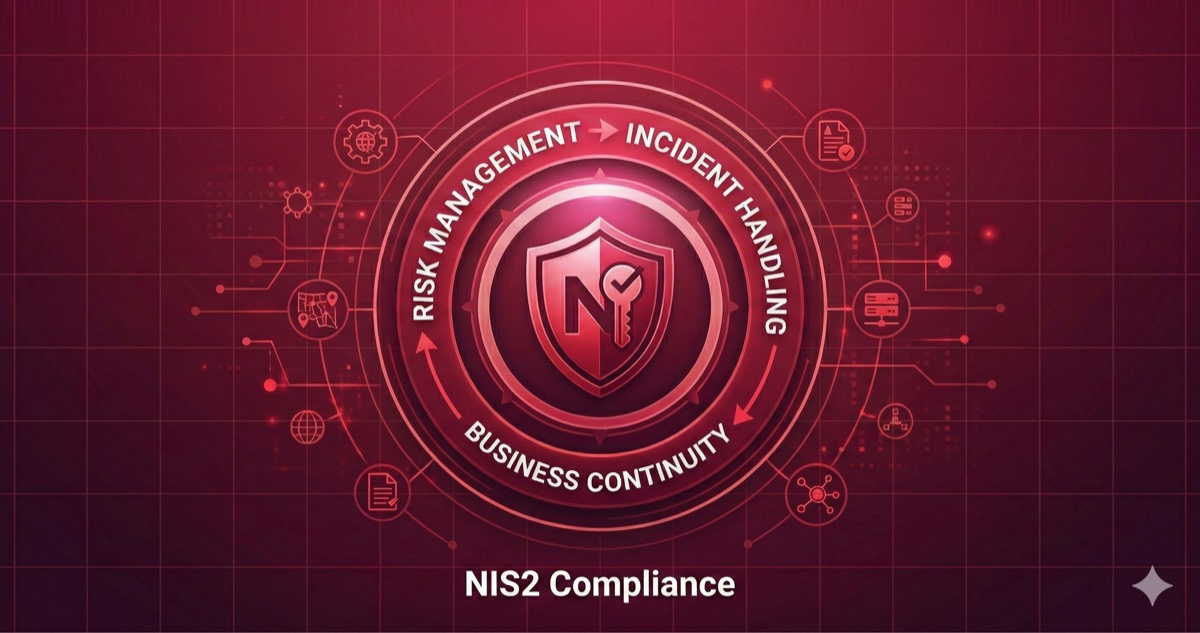
The NIS2 Directive (Network and Information Security Directive 2) is the EU’s most ambitious cybersecurity legislation. It replaces the original NIS Directive from 2016, dramatically expanding its scope and tightening requirements. NIS2 makes one thing clear: your cybersecurity is no longer just your problem — it’s everyone’s problem.
If a cyberattack takes down your company, the damage doesn’t stop at your door. Your customers lose service, your suppliers lose revenue, and entire sectors can be disrupted. NIS2 exists to make sure that doesn’t happen.
Who Does NIS2 Affect?
NIS2 applies to essential and important entities across 18 critical sectors. The scope is far broader than most organizations expect.
Essential Entities (Highest Requirements)
- Energy (electricity, oil, gas, hydrogen, district heating)
- Transport (air, rail, water, road)
- Banking and financial market infrastructure
- Healthcare (hospitals, laboratories, medical device manufacturers)
- Drinking water supply and wastewater management
- Digital infrastructure (DNS providers, TLD registries, cloud, data centers, CDNs)
- ICT service management (B2B — managed service providers, managed security providers)
- Public administration (central and regional government)
- Space
Important Entities
- Postal and courier services
- Waste management
- Chemical manufacturing and distribution
- Food production and distribution
- Manufacturing (medical devices, electronics, machinery, motor vehicles)
- Digital providers (online marketplaces, search engines, social networking platforms)
- Research organizations
Size Thresholds
NIS2 generally applies to medium and large enterprises: organizations with 50+ employees or €10M+ annual turnover. However, some entities are in scope regardless of size — DNS providers, TLD registries, and providers of public electronic communications.
The Supply Chain Factor
Critical: NIS2 doesn’t just apply to the entities listed above. It also reaches into their supply chains. If you’re a software vendor, cloud provider, or IT service provider to an essential entity, you may face NIS2 requirements indirectly — through contractual obligations your clients impose on you.
Key Requirements
NIS2 mandates a comprehensive approach to cybersecurity:
1. Risk Management Measures
Organizations must implement appropriate technical, operational, and organizational measures to manage cybersecurity risks. At minimum:
- Risk analysis and information system security policies
- Incident handling procedures
- Business continuity and crisis management
- Supply chain security (including security aspects of supplier relationships)
- Security in network and information system acquisition, development, and maintenance
- Vulnerability handling and disclosure
- Cybersecurity assessment and testing practices
- Cryptography and encryption policies
- Human resource security, access control, and asset management
- Multi-factor authentication and secure communication
2. Incident Reporting
NIS2 establishes strict, multi-stage incident reporting:
| Timeline | Obligation |
|---|---|
| 24 hours | Early warning to competent authority — initial notification that a significant incident has occurred |
| 72 hours | Full incident notification — initial assessment, severity, impact, indicators of compromise |
| 1 month | Final report — root cause analysis, mitigation measures, cross-border impact |
A “significant incident” is one that causes or could cause severe operational disruption or financial loss, or affects other natural or legal persons by causing considerable damage.
3. Management Accountability
This is new. NIS2 makes management bodies personally responsible for cybersecurity. Management must:
- Approve cybersecurity risk management measures
- Oversee their implementation
- Undergo cybersecurity training
- Be held liable for infringements
The CEO can no longer say “cybersecurity is IT’s problem.” Under NIS2, it’s the board’s problem.
4. Business Continuity
Organizations must have plans for:
- Backup management and disaster recovery
- Crisis management
- Ensuring continuity of essential or important services during and after an incident
5. Supply Chain Security
Entities must assess and manage risks from their direct suppliers and service providers. This includes:
- Evaluating the cybersecurity practices of suppliers
- Including cybersecurity requirements in contracts
- Monitoring and auditing supplier security
- Having contingency plans for supplier failures
Why NIS2 Matters
NIS2 reflects a fundamental shift in how the EU views cybersecurity: it’s no longer a technical issue — it’s a matter of societal resilience.
- Interconnected risk: A single compromised supplier can cascade across an entire sector. NIS2 forces organizations to think beyond their own perimeter.
- Competitive differentiation: Organizations that demonstrate strong NIS2 compliance become preferred partners and vendors.
- Insurance requirements: Cyber insurance providers increasingly require NIS2-level controls as a condition for coverage.
- Overlap with other frameworks: NIS2 compliance provides a strong foundation for ISO 27001, DORA, and CRA requirements.
What Happens If You Don’t Comply
The Fines
| Entity Type | Maximum Fine |
|---|---|
| Essential entities | Up to €10 million or 2% of global annual turnover (whichever is higher) |
| Important entities | Up to €7 million or 1.4% of global annual turnover (whichever is higher) |
Plus: personal liability for management — including potential temporary bans from exercising management functions.
A Scenario That Keeps CISOs Awake
This is an illustrative scenario based on real attack patterns.
A SaaS company provides invoicing and payment processing to 3,000 small and medium businesses. An attacker compromises their CI/CD pipeline through a stolen developer credential and modifies the payment gateway code. For 18 hours, every customer payment is silently redirected to the attacker’s account.
€340,000 stolen in one day.
The company didn’t have:
- An incident response plan
- Multi-factor authentication on their development infrastructure
- Supply chain security assessment from their clients
- Incident detection capabilities (it took 3 days to discover)
- Notification procedures (they never notified authorities)
Under NIS2:
- €10 million fine on top of the financial losses
- Personal liability for the CEO, who never approved a cybersecurity policy
- Mandatory public disclosure of the incident
- Regulatory supervision and mandatory remediation
- Every one of their 3,000 clients must report the supply chain incident to their own regulators
The attacker stole €340,000. The NIS2 consequences cost 30 times more.
How to Get Started
1. Determine If You’re in Scope
Check whether your organization falls under one of the 18 NIS2 sectors and meets the size threshold. Don’t forget: if you’re a supplier to essential entities, you may be indirectly in scope.
2. Conduct a Gap Assessment
Evaluate your current cybersecurity posture against NIS2’s ten minimum security measures. Identify where you fall short — most organizations find gaps in incident reporting, supply chain security, and management accountability.
3. Establish Incident Response
Build a multi-stage incident response capability aligned with NIS2’s 24h/72h/1month timeline. Designate responsible persons, create communication templates, and run tabletop exercises.
4. Engage Your Management
NIS2 requires board-level involvement. Brief your management on their new obligations, schedule cybersecurity training, and ensure they formally approve security policies.
5. Assess Your Supply Chain
Map your critical suppliers, evaluate their security posture, and update contracts to include cybersecurity requirements. This is often the hardest and most time-consuming step — start early.
NIS2 compliance is not optional, and the clock is ticking. The organizations that start now will be ready. Those that wait will be scrambling — and paying the price.
Ready to assess your compliance?
Start your free assessment today and find out where you stand with GDPR, NIS2, DORA, ISO 27001, and more.
Written by
Metrica.uno Team
Content Team
Metrica.uno Team is part of the Metrica.uno team, helping organizations navigate AI compliance with practical insights and guidance.
Related Articles
Cyber Resilience Act (CRA) Explained: Who It Affects, Requirements & Penalties
Everything you need to know about the CRA: who it applies to, security requirements for digital products, SBOM obligations, and consequences of non-compliance.
DORA Explained: Who It Affects, Requirements & Penalties
Everything you need to know about DORA: who it applies to, digital resilience requirements, ICT third-party risk management, and consequences of non-compliance.
ENS (Esquema Nacional de Seguridad) Explained: Requirements & Certification
Everything you need to know about Spain's ENS: who needs it, security requirements, certification levels, and why it's essential for Spanish public sector contracts.