NIST AI Risk Management Framework: What You Need to Know
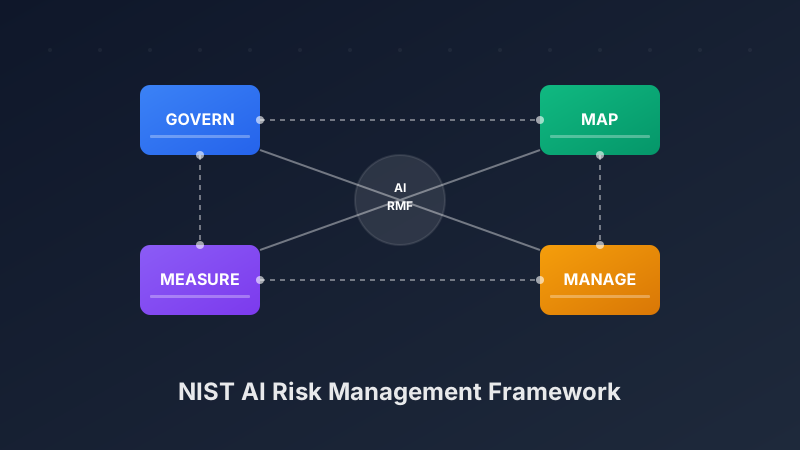
The National Institute of Standards and Technology (NIST) AI Risk Management Framework (AI RMF) provides a structured approach for managing risks associated with AI systems. Unlike regulatory mandates, the AI RMF is voluntary, but it’s increasingly becoming a de facto standard for AI governance in the United States and beyond.
What is the NIST AI RMF?
Released in January 2023, the NIST AI RMF is a guidance document designed to help organizations:
- Identify and manage AI risks throughout the AI lifecycle
- Promote trustworthy AI that is valid, reliable, safe, secure, and accountable
- Enable responsible AI practices aligned with organizational values and legal requirements
The framework is technology-neutral and use-case agnostic, making it applicable across industries and AI applications.
Core Functions
The AI RMF is built around four core functions:
1. Govern
The Govern function establishes the organizational culture and structure for AI risk management. Key activities include:
- Establishing AI governance policies and procedures
- Defining roles and responsibilities
- Setting risk tolerance levels
- Ensuring diverse perspectives in AI development
- Creating accountability mechanisms
2. Map
The Map function focuses on understanding the context in which AI systems operate:
- Identifying intended purposes and potential uses
- Understanding the operational environment
- Recognizing stakeholders and their interests
- Documenting assumptions and limitations
- Assessing potential impacts on individuals and groups
3. Measure
The Measure function involves assessing and tracking AI risks:
- Evaluating AI system performance and reliability
- Testing for bias and fairness
- Assessing security vulnerabilities
- Measuring transparency and explainability
- Monitoring for emergent risks
4. Manage
The Manage function addresses how organizations respond to identified risks:
- Prioritizing risks for treatment
- Implementing risk mitigation strategies
- Allocating resources appropriately
- Establishing incident response procedures
- Continuously improving risk management practices
Trustworthy AI Characteristics
The AI RMF promotes seven characteristics of trustworthy AI:
- Valid and Reliable: AI systems perform as intended consistently
- Safe: AI systems don’t endanger human life, health, or the environment
- Secure and Resilient: AI systems withstand attacks and recover from failures
- Accountable and Transparent: Clear responsibility and explainable decisions
- Explainable and Interpretable: Outputs can be understood by relevant parties
- Privacy-Enhanced: Personal data is protected appropriately
- Fair with Harmful Bias Managed: Bias is identified and mitigated
Implementation Approach
Phase 1: Foundation
Start by establishing the governance foundation:
1. Assign AI governance responsibility
2. Define organizational AI policies
3. Establish risk tolerance thresholds
4. Create cross-functional AI teams
5. Develop training programs
Phase 2: Assessment
Map your AI landscape and assess risks:
1. Inventory AI systems and projects
2. Document system characteristics
3. Identify stakeholders and impacts
4. Conduct initial risk assessments
5. Prioritize systems for deeper review
Phase 3: Measurement
Implement measurement and monitoring:
1. Define metrics for each system
2. Establish testing protocols
3. Implement bias detection tools
4. Create monitoring dashboards
5. Set up alerting mechanisms
Phase 4: Management
Develop and execute risk management strategies:
1. Create risk treatment plans
2. Implement mitigation controls
3. Establish review cycles
4. Develop incident response plans
5. Iterate and improve continuously
Relationship with Other Frameworks
The AI RMF is designed to complement other frameworks and regulations:
| Framework | Relationship |
|---|---|
| EU AI Act | Aligned concepts, can support compliance |
| ISO 42001 | Complementary approaches to AI governance |
| GDPR | Supports privacy requirements |
| Sector regulations | Adds AI-specific considerations |
Benefits of Adoption
Organizations implementing the AI RMF typically see:
- Reduced risk of AI-related incidents and failures
- Increased trust from customers and stakeholders
- Better alignment with emerging regulations
- Improved collaboration across teams
- Competitive advantage in AI governance maturity
Getting Started with Metrica.uno
Metrica.uno helps organizations implement the NIST AI RMF by:
- Providing structured assessments aligned with AI RMF functions
- Mapping your AI systems to framework requirements
- Identifying gaps in your current practices
- Generating compliance reports for stakeholders
- Tracking improvements over time
Start your free assessment to see how your organization aligns with the NIST AI RMF.
Ready to assess your compliance?
Start your free assessment today and find out where you stand with GDPR, NIS2, DORA, ISO 27001, and more.
Written by
Metrica.uno Team
Content Team
Metrica.uno Team is part of the Metrica.uno team, helping organizations navigate AI compliance with practical insights and guidance.
Related Articles
Cyber Resilience Act (CRA) Explained: Who It Affects, Requirements & Penalties
Everything you need to know about the CRA: who it applies to, security requirements for digital products, SBOM obligations, and consequences of non-compliance.

DORA Explained: Who It Affects, Requirements & Penalties
Everything you need to know about DORA: who it applies to, digital resilience requirements, ICT third-party risk management, and consequences of non-compliance.

ENS (Esquema Nacional de Seguridad) Explained: Requirements & Certification
Everything you need to know about Spain's ENS: who needs it, security requirements, certification levels, and why it's essential for Spanish public sector contracts.